
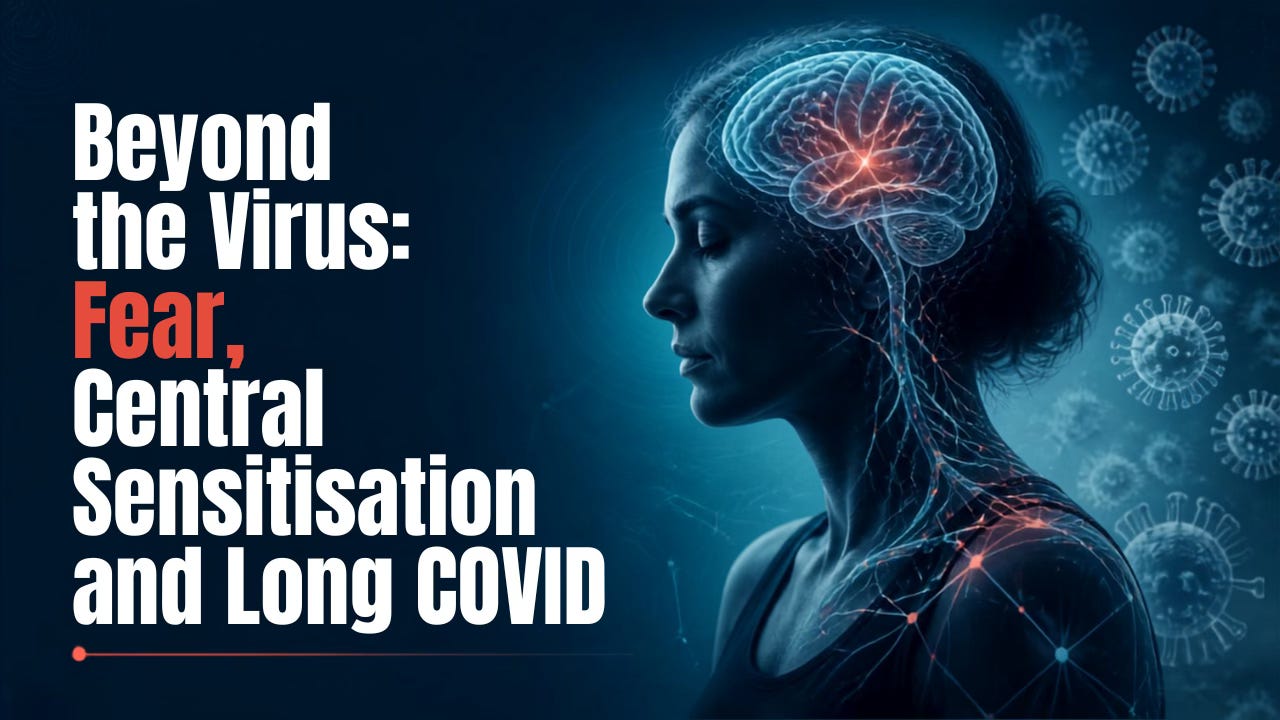
A response to “When the Illness Ends but the Body Doesn’t Get the Message”
An article recently published by Pain Reprocessing Therapy, “When the Illness Ends but the Body Doesn’t Get the Message”, offers an important explanation for why symptoms can persist after an apparent illness has passed.
The article discusses conditions attributed to infectious agents, including Epstein–Barr virus (EBV), which is said to cause mononucleosis or glandular fever; Borrelia burgdorferi, the bacterium associated with Lyme disease; and SARS-CoV-2, which is said to cause COVID-19. Its central argument is that an infection may end while the brain and nervous system continue to behave as though the threat remains. The original biological danger may have passed, but the body can remain caught in a protective state, producing very real fatigue, pain, cognitive difficulties and other symptoms.
This is a useful challenge to the assumption that persistent symptoms must always mean persistent tissue damage or an active disease process. It recognises the role of learned neural pathways, fear, hypervigilance and central sensitisation. These are subjects that deserve far more attention in conversations about chronic pain and medically unexplained symptoms.
However, I believe the article begins with assumptions that also deserve to be questioned.
What if the original story is wrong?
The conventional account starts with a pathogen: a virus or bacterium invades the body, causes illness and is subsequently controlled or eliminated. If symptoms remain, the nervous system may have failed to recognise that the pathogen has gone.
But what if the alleged pathogen was never scientifically demonstrated to be the cause of the illness in the first place?
After spending hundreds of hours studying the foundations of virology, germ theory, Terrain Theory and pleomorphism, I no longer find the conventional account persuasive. I am not claiming that science has proved viruses do not exist. My position is that virology has not produced valid scientific evidence establishing that the particles it calls viruses exist as independently occurring, disease-causing agents.
This is a crucial distinction.
The question is not whether people become unwell. They clearly do. Nor is it whether researchers can observe cellular damage, genetic material or extremely small particles. The question is whether those observations demonstrate the existence of the specific pathogenic entities assumed to have caused the illness.
Critics such as Dr Mark Bailey argue that virology begins by assuming the presence of a virus and then interprets the subsequent experimental findings through that assumption. In A Farewell to Virology, Bailey examines what he considers the logical and methodological problems underlying viral isolation, cell culture, genome construction and claims of pathogenicity.
Mike Stone similarly argues that a circular process takes place: a virus is presumed to be present in material taken from a sick person; the material is added to a laboratory cell culture; changes in the culture are attributed to the presumed virus; and those changes are then offered as evidence that the virus was present. His discussion of these alleged logical fallacies can be read in “ViroLIEgy 101: Logical Fallacies.”
Those criticisms do not deny illness. They dispute the interpretation placed upon laboratory observations.
What do the control experiments show?
One of the central claims of virology is that a cytopathic effect—the deterioration and death of cells in a culture—provides evidence of viral activity. However, critics point to control experiments associated with Dr Stefan Lanka and Jamie Andrews in which similar cytopathic effects were reportedly produced without adding material alleged to contain a virus.
The contention is that starvation, antibiotics, antifungal drugs and other laboratory conditions can damage the cells themselves. If supposedly uninfected control cultures deteriorate in a manner resembling “virus-infected” cultures, cellular deterioration cannot, by itself, demonstrate that a virus caused the effect.
This raises several questions that should not be dismissed:
Was the purported virus shown to exist independently before the experiment began?
Was it separated from all other biological material and characterised directly?
Were control cultures subjected to precisely the same conditions?
Could the laboratory procedure itself have produced the observed cellular damage?
Does detecting fragments of genetic material prove that they came from the hypothesised particle?
Has causation been demonstrated, or inferred from an assumed association?
Further discussion of these objections can be found in this interview concerning the control experiments and the foundations of virology.
Genetic sequencing is frequently offered as an answer to such criticisms. However, critics question whether assembling genetic sequences from numerous fragments—using computerised alignment against a reference genome—independently establishes the physical existence and origin of the entity being claimed. That substantial subject deserves its own article. For the present discussion, it is sufficient to recognise that a computer-generated sequence is not automatically equivalent to the direct demonstration of a purified, naturally occurring, disease-causing particle.
EBV, glandular fever and diagnostic labels
The original article refers to Epstein–Barr virus as the cause of mononucleosis. Conventional medicine treats this relationship as established. The alternative view questions whether the laboratory findings attributed to EBV demonstrate causation or whether a collection of symptoms and indirect test results has been organised beneath a viral label.
Dr Sam Bailey explores this argument in “Glandular Fever and the Fable of EBV.” Her analysis asks whether an assumed viral explanation has displaced a broader investigation of the conditions in which illness develops.
The same underlying question can be asked about Borrelia burgdorferi and other organisms described as pathogens. Finding a microorganism, antibody, genetic sequence or biochemical marker in association with illness is not necessarily the same as demonstrating that it independently caused the illness. Association, interpretation and causation must not be quietly collapsed into one another.
An extended critique of the logical basis of germ theory is offered in “An Inquiry into the Logical Basis of the Germ Theory,” alongside a collection of articles examining claims of contagion in “Infectious Myth Busted.”
Terrain rather than invasion
Terrain Theory begins with a different question. Instead of asking only, “Which external pathogen attacked this person?”, it asks, “What conditions within and around this person allowed illness to develop?”
Those conditions may include nutritional deficiencies, toxicity, impaired elimination, metabolic dysfunction, sleep deprivation, circadian disruption, psychological stress, emotional conflict and an overwhelmed nervous system. Pleomorphism proposes that microorganisms may change their form and behaviour in response to alterations in their biological environment, rather than always behaving as fixed external enemies that independently create disease.
From this perspective, microorganisms may be associated with diseased tissue without necessarily being its primary cause. They may be consequences, participants or adaptive responses within a disturbed terrain.
This does not mean that hygiene, sanitation or sensible precautions are worthless. It means that the presence of illness should not automatically close discussion about causation. The health of the host—the person’s physical, biochemical, neurological, emotional and social terrain—may be at least as important as anything detected in a laboratory.
Was fear itself a major biological load?
The original article proposes that the nervous system can remain stuck in danger after an illness. I agree with this principle, but question whether the alleged infection was necessarily the main danger that conditioned the nervous system during 2020 and 2021.
For almost two years, populations were exposed to relentless messages of threat. Case numbers and deaths dominated news coverage. People were encouraged to view other human beings as potential sources of danger. Physical contact, social connection, work, exercise, funerals, weddings and ordinary freedoms were heavily restricted.
Some people feared illness and death. Others feared losing their livelihood, bodily autonomy, relationships or fundamental freedoms. Many feared both.
Whichever interpretation someone held, the nervous system received the same basic message: you are not safe.
Chronic fear can increase vigilance, alter breathing, disrupt sleep, increase muscular tension, affect immune and endocrine activity and amplify the brain’s interpretation of sensory information. In someone whose total load already approaches or exceeds their capacity, prolonged fear may contribute to central sensitisation: the nervous system becomes more responsive to potential threat and may continue producing protective symptoms long after the immediate circumstances change.
There is evidence that this relationship deserves attention. A prospective cohort study found that depression, anxiety, perceived stress, loneliness and worry about COVID before a reported positive test were associated with a greater likelihood of subsequently reporting post-COVID conditions (Wang et al., 2022). This does not prove that fear explains every case, but it challenges attempts to separate persistent symptoms from the psychological and social environment in which they developed.
The body may indeed have “failed to get the message” that the danger had ended. But perhaps the danger signal was not simply an infection. Perhaps it was the 24-hour media cycle, social isolation, disrupted routines, economic insecurity, fear of other people and a profound loss of control.
What about the injections?
Any honest investigation of symptoms labelled Long COVID should also examine the timing of COVID-19 injections, subsequent symptoms and recognised or possible adverse effects.
This does not mean assuming that every persistent symptom was caused by an injection. Symptoms described as Long COVID were reported before mass vaccination, so vaccination cannot provide a complete explanation for the entire phenomenon. Conversely, that fact should not be used to dismiss people whose symptoms began or changed following an injection.
Several possibilities may exist within a diagnostic category as broad as Long COVID:
symptoms arising after an acute period of illness;
nervous-system sensitisation reinforced by fear and threatening explanations;
the effects of isolation, inactivity, disrupted sleep and loss of purpose;
metabolic or inflammatory dysfunction attributed to an assumed pathogen;
adverse effects following a medical intervention;
combinations of several physical, biochemical, neurological, emotional and social loads.
Lumping these different experiences beneath one label risks hiding their individual causes. A diagnosis describes a pattern; it does not necessarily explain why that pattern developed in a particular person.
A broader question about safety
Pain, fatigue, cognitive difficulty and other persistent symptoms are real, irrespective of the explanatory model applied to them. People experiencing them should never be told that the symptoms are imaginary or “all in their head.” At the same time, they should not be frightened into believing that an invisible invader has permanently damaged them when that causal story has not been established to the standard they assume.
Pain and other protective symptoms emerge when the brain concludes that the person is under threat and that protection is required. That perceived threat can arise from physical, biochemical, neurological, emotional and social influences. The more influences that accumulate, and the longer they remain, the more likely the person’s total load is to exceed their available capacity.
Pain Reprocessing Therapy makes an important contribution by helping people reinterpret symptoms and restore a sense of safety. But we should be willing to take its central insight one step further.
What if the nervous system is not merely holding on to a danger that has passed? What if some of the danger was created and continually reinforced by the story people were told about their bodies?
What if symptoms labelled Long COVID cannot be understood through a single alleged pathogen?
And what might become possible if, instead of reinforcing fear of invisible enemies, we helped people reduce their total load, rebuild their physical and psychological capacity, restore trust in their bodies and experience safety again?
These questions deserve open scientific discussion. Questioning an accepted explanation is not the same as denying suffering. On the contrary, it may be necessary if we genuinely want to understand why people remain unwell—and help them participate in their recovery.
References and further reading
Bailey, M. (n.d.). A Farewell to Virology / Settling the Virus Debate. https://drsambailey.com/resources/settling-the-virus-debate/
Bailey, S. (n.d.). Glandular Fever and the Fable of EBV. https://drsambailey.com/resources/videos/viruses-unplugged/glandular-fever-and-the-fable-of-ebv/
Bailey, S. (n.d.). Why Nobody Had “Caught” or “Got” COVID-19. https://drsambailey.com/why-nobody-had-caught-or-got-covid-19/
Stone, M. (2024, September 5). ViroLIEgy 101: Logical Fallacies. https://viroliegy.com/2024/09/05/viroliegy-101-logical-fallacies/
Stone, M. (2025, July 17). An Inquiry into the Logical Basis of the Germ Theory. https://viroliegy.com/2025/07/17/an-inquiry-into-the-logical-basis-of-the-germ-theory/
Stone, M. (n.d.). Infectious Myth Busted. https://viroliegy.com/category/infectious-myth-busted/
Wang, S., Quan, L., Chavarro, J. E., et al. (2022). Associations of depression, anxiety, worry, perceived stress, and loneliness prior to infection with risk of post–COVID-19 conditions. JAMA Psychiatry, 79(11), 1081–1091. https://doi.org/10.1001/jamapsychiatry.2022.2640
Author’s note: This article presents a critical and alternative interpretation of virology, germ theory and persistent post-COVID symptoms. It is intended to encourage examination and discussion, not to diagnose disease or advise readers to begin, discontinue or avoid medical treatment.